

Why Government AI Fails Without Document Control (and How Varonis Fixes It)
Author: Beth Laws
Release Date: 23/07/2026
Government agencies are standing at a digital crossroads. On one hand, the promise of Artificial Intelligence (AI), to clear asylum backlogs, automate routine casework, and provide 24/7 citizen support is more tantalising than ever. On the other hand, most agencies are trying to build this high-tech future on a foundation of "document chaos."
The hard truth? AI won’t save the government until the government saves its data from itself.
The Problem: A "Hiden Data Crisis"
For decades, the public sector has accumulated a staggering amount of both unstructured and structured data, PDFs, emails, spreadsheets, and case files, scattered across hundreds of disconnected repositories, and somehow all this data just seems to keep growing. This is known as content sprawl.
When you feed unmonitored or unmanaged data into an AI, you get “unmonitored” results. If an AI agent summarises a policy using an outdated draft instead of the 2024 final version, the result isn't just a technical glitch; it’s a reputational and regulatory disaster. Furthermore, if your data permissions are wide open, an AI agent might accidentally expose a sensitive HR file or a restricted security brief into a routine employee query.

Varonis: The "Data-First" Engine for Government AI
Varonis is a partner with Somerford and it doesn't just monitor the network; it secures the data itself. For government leaders looking to bridge the gap between document chaos and AI readiness, Varonis provides the technical "legwork" required to make AI safe and scalable.
Varonis addresses the specific challenges identified in the article:
1. Eliminating the "Blast Radius" with Automated Lest Privilege
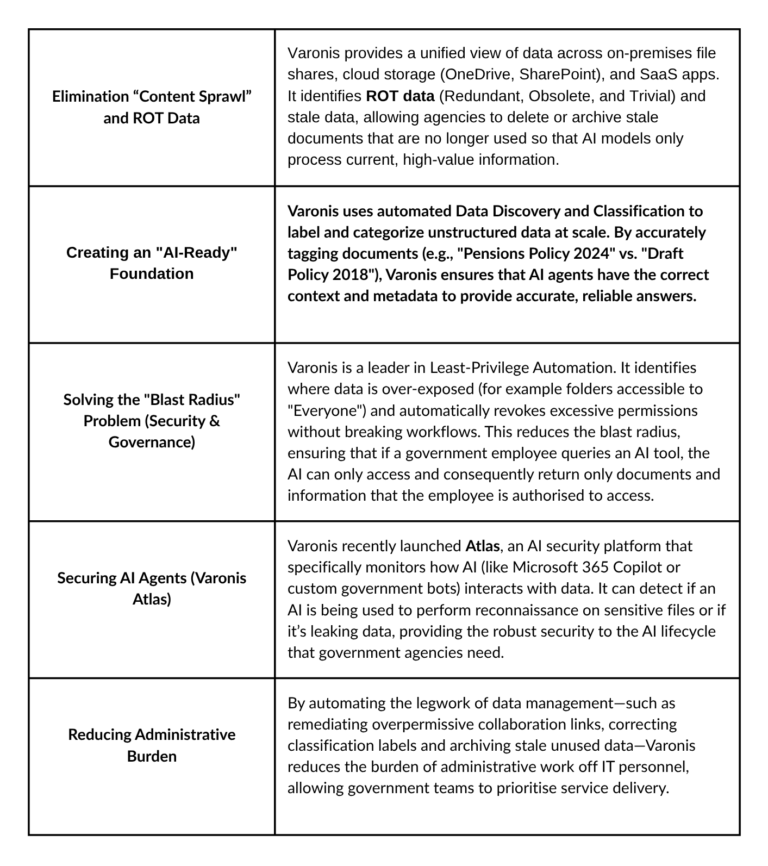
AI can inadvertently surface sensitive information to unauthorised users. Varonis solves this by automatically mapping every user, every file, and every permission. It identifies where data is "over-exposed", for example folders accessible to everyone in the organisation that shouldn’t be, and uses Least-Privilege Automation alongside their User Behaviour Analytics technology to revoke excessive access without breaking a single employee's workflow.
By reducing the blast radius, you ensure that when an AI crawls your environment, it only can access what the specific user is allowed to see, preventing sensitive data being accidentally exposed by AI.
2. Transforming Document Chaos into AI-Ready Assets
AI requires context. Varonis uses its Data Discovery and Classification technology to automatically label and categorise structured and unstructured sensitive data. Whether it’s PII (Personally Identifiable Information), PCI-regulated data, or files subject to GDPR, Varonis will find it.
The Result: You can point your AI at "Clean Data," ensuring it draws from the most current, accurate, and authorized documents.
3. Securing the AI Lifecycel with Varonis Atlas
As agencies move from pilots to "practical agents," they need constant oversight. Varonis Atlas is a dedicated AI security platform that monitors how AI tools (like Microsoft 365 Copilot) interact with your data in real-time.
- It detects "shadow AI" (unauthorised bots).
- It blocks "prompt injection" attempts where a user might try to trick the AI into revealing sensitive secrets.
- It provides a full audit trail of what the AI accessed and why.
The Force Multiplier: Doing More with Less
The article correctly notes that government teams are "stretched" and shouldn't spend months on "rip-and-replace" programs. Varonis acts as a force multiplier by automating the "unglamorous work" of data hygiene. It identifies and deletes stale accounts, fixes broken permissions, and labels millions of files in the background, requiring zero manual effort from already overburdened IT staff.
Conclusion:
You wouldn't build a skyscraper on a swamp. Similarly, you cannot build a reliable, ethical and secure AI using unmanaged and overexposed data.
Varonis provides the "sound information foundation" the public sector needs. By giving agencies total visibility and automated control over their documents, Varonis turns a "hidden data crisis" into a secure, searchable asset, finally making the dream of an AI-enabled government a reality.
Transform a "hidden data crisis" into a structured, secure, and searchable asset, making the dream of "AI-enabled government" technically viable and safe.